Friday, April 3, 2015

How Our Kids Ended Up Mostly Wheat Free

It was hard enough for my husband and I to become mostly wheat free.  But our change also affected our children, who were 7 and 5 at the time.  Since we eat as a family for most meals, and I make one meal for everyone, the kids naturally started to eat less wheat.  To make the shift to wheat free easier it was best not to have any wheat products in the house.  We no longer bought bread (including waffles, bagels, and donuts), crackers, or pasta.   Instead we stocked up on veggies, nuts, fruits, and other whole foods.  Rice cakes and popcorn became snack staples early on.  As our kids eventually ate more vegetables, nuts, and fruits they stopped asking for cereal, goldfish, or other processed snacks and foods they used to love.  The rule in our house became if you are hungry between meals you can have as many vegetables and nuts that you want.  We have since refined this a little to be most vegetables, and a small amount of nuts – as we have learned it is possible to have too many nuts.  If there is something that they want – like banana bread – we now make it in healthier way using almond or coconut flour.

One of the biggest challenges in the beginning was breakfast.  Cereal and toast were so easy.  Now what?  When we stopped buying cereal the kids would search and search for something that they recognized as breakfast.  There would even be frequent outburst of “I wish you guys didn't read that stupid book!”  At times I wondered why we were doing this, and if it would make a difference for them.   From what we had learned, eating less when was the right thing, so we pushed on.  Breakfast became a rice cake topped with peanut butter, banana, and a sprinkle of cinnamon, or a bowl of oatmeal with berries, nuts, and a drizzle of honey.  While those are better choices compared to cereal and toast, they got boring quickly.  We soon began to think out of the box.  Breakfast has become more about what do we feel like eating.  Some days breakfast is eggs and bacon or oatmeal, other days it’s a salad with lunch meat, or celery sticks with peanut butter.  Our kids think it’s fun to have other foods for breakfast – and not stick with the traditional breakfast foods.

My son's lunch
Lunch was also a challenge at first too.  Our kids liked to have grilled cheese, peanut butter and jelly sandwiches, or macaroni and cheese for lunch.  Our daughter even got hooked on Ramen noodles – this was the food item she asked for the longest.  Packing school lunch was easy with these quick convenience foods; even the Ramen noodles went to school in a thermos.  When we stopped buying bread and noodles there was some resistance for reading that “stupid book”.  In the beginning lunch was fruit and a granola bar like usual, but getting some protein in there seemed harder.  Cheese sticks, yogurt, and beans became part of their normal lunches.  On the weekends and no-school days lunch wasn't much easier, and once again I had to remember why we made this change, and look to the Internet and Pinterest for help.  Today lunches are still the most difficult for me, but include many more choices.  Our kids eat tuna or egg salad, other various salads, fruit, carrots, nuts, protein bars, rolled up lunch meat, soup, or beans for lunch.  There is still as occasional request for Ramen noodles, but not a fight over them.  She even loves spaghetti squash with meat sauce now, and takes this for lunch on occasion.

It’s been two and a half years since we got rid of most of the wheat.  Over time we all noticed differences in how we felt that we didn't realize were connected to the foods we ate.  Over the past year we realized that our daughter has a sensitivity to milk products.  After cutting out wheat we began to see a pattern of stomach pain, bloating, and congestion after she ate dairy.  Yogurt was great as a snack, cheese sticks were good for packing lunches, and of course many meals are just better when topped with cheese.   Realizing that dairy might be causing some of what our daughter was feeling we deiced to remove all milk products as well.  Now our daughter does not have belly pains or stomach bloat and could not be happier.  She knows what she feels like when she has dairy – so much so that she self-regulates when it comes to dairy products.  She does eat some dairy at time, but not very often.   We are not concerned about her bone health because she gets a lot of calcium and vitamin D from eating vegetables, beans, and fish.

Another notable time when our kids notice a difference in how food makes them feel is when they visit grandma’s house.  We realize not everyone is wheat free, and do not rule with an iron fist when it comes to what the kids eat when not at home.  However, they have learned on their own.  A few times after visiting grandma and having a donut, cookies, or pizza they have had an upset stomach, headache, or became moody.  We gently remind them of how they ate differently, and now they feel this way.  While they don’t want to believe us they test this theory on occasion.  However, they are starting to see the connection and choose to either avoid the foods completely or not over-indulge and be satisfied with just one or two bites.


While it seemed like hell at times, we made it through.  There is still an occasional outburst of “I wish you guys didn't read that stupid book!”  But as a family we have come a long way.  Sticking to what we learned and enforcing the mostly wheat free lifestyle has paid off, and it has become second nature to grab a handful of baby carrots, snow peas, or celery with nut butter as a snack. Our kids have adjusted just fine, and actually choose vegetables, fruits, and nuts on their own.  We feel better than we have in the past now that we have made the connection between what we put in our mouths and how it makes us feel.

Tuesday, March 24, 2015

Tasty Tuesday: Salmon Cakes and Cucumber Tomato Salad

When I was growing up my grandmother would make the best salmon cakes!  She passed away when I was 8, but I can still taste them, and have been trying to re-create that taste ever since.  I eventually gave up.  Over the past few years I have learned more and more about the benefits of fish oil, and salmon keeps popping up as a great source for Omega-3’s.  I am not a big fan or salmon by itself.  But with all the benefits I decided to search again for a good salmon cake recipe, and recently stumbled upon one from Practical Paleo.  I have made a few changes to make it my own, and have paired it with a cucumber tomato salad.  

Salmon Cakes
Adapted from Practical Paleo
Serves 2-4

2 – 6 ounce cans of wild salmon, drained
2 eggs, beaten
3 tablespoons green onions, finely chopped
1/4 teaspoon garlic powder, or 1 clove fresh minced garlic
1/2 teaspoon rosemary
1 Tablespoon Dijon mustard
Salt & pepper to taste
Coconut oil for pan


Directions:
1. Combine the salmon, eggs, green onions, rosemary, Dijon mustard, and salt and pepper in bowl.  The mixture will be mushy.
2. Heat a large pan over medium heat and add about 3-5 Tablespoons of coconut oil. When the coconut oil melts it should cover the pan and come 1/8 of an inch up the sides.
3. Make 4 salmon patties from the mixture and add to the pan when hot.
4. Allow the salmon cakes to cook and brown slightly on one side before flipping, about 5 minutes.
5. Flip the salmon cake and cook on the other side until done.
6. Serve with a slice of lemon


Cucumber Tomato Salad
Serves 2-4

1 Cucumber, halved lengthwise, and sliced
1 Medium tomato, diced
2 Tablespoons apple cider vinegar
2 teaspoons balsamic vinegar
4 teaspoons lemon juice
2 teaspoons extra virgin olive oil
2 Tablespoons Italian seasoning
Salt & pepper to taste

Directions:
1. Wisk apple cider vinegar, balsamic vinegar, lemon juice, and oil in a small bowl.
2. Combine cucumber, tomato, and Italian seasoning in a medium bowl.
3. Pour dressing over cucumber and tomatoes.  Mix well.

Serve room temperature of chilled

While I've only had this salmon cake recipe once I must say it is by far my favorite.  Not only does it fit our mostly wheat free lifestyle, but it also has a flavor reminiscent of grandma's salmon cakes.


Tuesday, March 10, 2015

Tasty Tuesday: Spaghetti with Meat Sauce

Spaghetti with meatballs.  Spaghetti with garlic and butter.  Shrimp scampi.  These all have a few things in common.  Yes, of course they all include spaghetti.  But they are also quick family staples, comfort food for some, and foods that we didn't think we would be able to enjoy since going wheat free.  

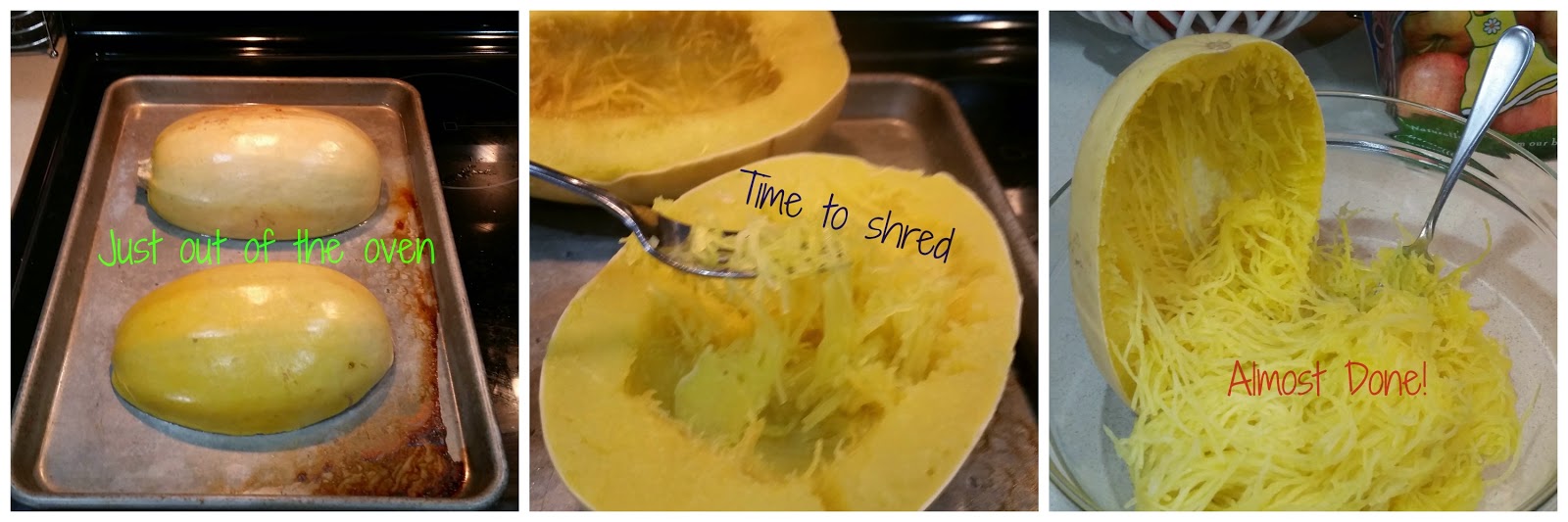
Thankfully, there is an alternative.  Until a few years ago I had never heard of spaghetti squash.  And I sure didn't know how to cook it, or how it tasted.  I have learned that I like spaghetti squash, quite a lot, actually.  My kids love spaghetti squash too, and don't miss the old, processed stuff.

Here is a my favorite way to cook spaghetti squash.  This is also an easy recipe to put together Sunday evening and pack for lunches throughout the week.

How to Cook Spaghetti Squash

  • Preheat the oven to 400 °F 
  • Cut the squash in half lengthwise - you  might need a pretty heavy duty knife to do this.
  • Then use a spoon to scoop out the seeds in the middle.  You can toss them out, or roast them just like pumpkin seeds.  


  • Arrange squash on a cookie sheet, or 13 x 9 pan, cut sides down. 
  • Pour 1/2 cup water into the dish and bake until just tender, 30 to 40 minutes.  You will know it is done when a fork goes all the way through the flesh to the skin.
  • Allow to cool for 5 - 10 minutes.
  • Scrape a fork back and forth across the squash to remove the insides.  It should look like spaghetti!


For this post I chose to make a quick meat sauce to serve over the spaghetti.  All I did was brown some lean ground beef until it was no longer pink and drained away the grease.  Then I added about 3/4 of a jar of my favorite pasta sauce - Newman's Own Organic - and tossed it together.   Voila!


A normal serving is 1/2 of a cup of squash.  Feel free to measure it out first and then top with sauce.


Sunday, March 8, 2015

How We Got to be Wheat Free (Well, Almost)


Years ago when I was going to the gym I believed that as long as I was working out and burning calories I could eat whatever I wanted.  The same was true when I started running in 2010.  I thought I could out run bad food choices. But that was not the case.  After having our second child in 2007 something else changed.  What worked in the past, what I thought was a healthy diet, didn't seem to work.  We ate the traditional food pyramid, yet, despite all my exercise, I could not seem to lose weight.  In addition I just felt awful – physically, mentally, and emotionally.

Our diet consisted of whole grain cereals with 1% or skim milk or whole wheat waffles or bagels for breakfast, deli sandwiches on whole wheat bread for lunch, and dinner was pasta (once or twice a week) along with chicken, ground beef or pork and maybe some vegetables.  Snacks throughout the day were usually low fat yogurt with granola, or a granola bar of some sort.  And of course there was the after dinner treat, usually low-fat frozen yogurt.  Why didn't I feel healthy?  I was following what we thought was a healthy diet. 

I would eat a good breakfast, and be starving only 2 hours later.  Or have a huge bowl of pasta and have the worst stomach pains after and thought “Man, I ate way too much!”  Other times I would have a nice bowl of Cheerios with banana and milk for breakfast and have more stomach pains.  This breakfast seemed so simple and healthy, but what I didn't realize it that it is the cause of my pain.  Honestly, I didn’t think to go to a doctor because I didn't think there was anything really wrong with me.  This was how I lived for many years, until my husband read the Wheat Belly book by Dr. William Davis and Good Calorie, Bad Calorie by Gary Taubes.

These books were a huge light bulb!  It described most of my symptoms to a tee, and some I didn't realize here symptoms. Can you guess what the “cure” was?  Remove all wheat and wheat products from your diet.  What?  That seemed crazy since we are constantly told to eat “healthy whole grains”.  If it’s healthy, how can it hurt me?  Well, wheat is not all it is cracked up to be, and the effects on our bodies are far from anything healthy.  You know that feeling when you eat cereal, toast, or a bagel for breakfast are starving two hours later?  That is due to the impact wheat has on your blood sugar.  The processed carbs found in these breakfast foods quickly turn to sugar and your body either burns through them, or if you don’t need them at the time they get locked away as fat.  In addition, there really aren't a whole lot of nutrients in wheat, so your body is starving for real foods in search of the nutrients it needs to fuel your body.

Whoa!  So we decided to give it a shot and remove all wheat based products, and a few others mentioned in Wheat Belly, and see how it went.  This seemed hard and I was constantly looking for “wheat replacements” - which I don’t recommend trying to do.  If you’re going to remove wheat just do it!  Don’t look for things to replace the things you once love; you’ll be happier in the long run.  But within 8 days I began to feel better – not as much stomach pain around meals. 

About two more weeks later I noticed a big differences.  My energy levels were higher than ever, and I even slept better.  In addition that little belly “pooch” (ladies you know what I’m talking about!) started to go away.  I stepped on the scale for the first time in months and had lost 8 pounds!  What was happening was my body was less inflamed from trying to digest the wheat, and my body was getting the nutrients it needed so I wasn’t always looking for something to eat.   Another change I had noticed was my emotional and mental states seemed to improve.  I no longer felt “down” most of the time.  What I learned is there is a connection between the gut and the brain.  A protein found in wheat wreaks havoc on your gut and brain ultimately leading to depression and anxiety.    If you want to read more about this connections check out this article by Dr. Mercola.

This has been a learning process.  In the beginning we tried to remove everything wheat-based from our diets, along with milk and yogurt.  Here is an extensive list that we used in the beginning.  However, we realized that this might not be 100% sustainable over time.  There are a few things that we do eat today, such as oatmeal, bacon and deli meats, some corn, the occasional French fry when we go out to eat, and occasional sweets.  We are not perfect, but this is what works for us.  It’s about balance and moderation.  Will we ever eat regular pizza again?  Probably not.  I did have regular pizza once or twice since going wheat free and the resulting pain, bloating, and ikiness were so bad I never want to feel that way again!

So, just from removing wheat I felt better in so many ways – I had more energy, no more brain fog, improved sleep, better mood, and even lost weight.  I feel better than I have in a long time! If you have any questions, or need help going wheat free, please let me know.  I would be more than happy to help!

Friday, February 27, 2015

Exercise Enthusiast to Runner and Beyond


I love fitness!  It has become like an addiction.  In college, and mostly after, I liked to be in the gym lifting weights and "workin' on my fitness".  I've also done some home video programs such as Cindy Crawford, Tae Bo, and The Biggest Loser Yoga, just to name a few.

In 2010 my husband and I even tried out this hard core workout called P90X.  Wow was it tough, but it was good!  I made it through 12 out of 15 weeks, not bad.  Around the same time as P90X, I started running and had no idea what running would mean for me.  I thought you just go out and do it, one foot in front of the other. But running has become my release, my therapy, and my passion.

The more I learned about running the more I loved it, and the less time I spent in the gym.  Well, it finally caught up with me.  In the fall of 2011 I became an injured runner.  Severe tightness in my calf - no tear - told to rest.  What?  No way!  I had to run.  I needed to run.  So a friend recommended active release therapy. (Check out the link to my friend Tabatha's site for more information about ART) Wow! I was back in business after 1 session (results vary!) But it took me some time to get back to feeling confident in my running. Then tarsal tunnel showed up in early 2012 and I was sidelined again.  Back to Tabatha.  After a few sessions I was once again back in business.  But that's when I realized I needed more than just running to be a good runner.  There was something that I was missing. I needed to cross train.  

Cross training for a runner is about building up all the other muscles that support you when you run.  It had been a while since I had been to the gym, and with children at home I was not sure how to go about cross training without a gym.  I tried to plan my own workouts at home, but I was missing the motivation. About this time Insanity by Shaun T was a popular infomercial I had seen and thought - that is just insane, who would do that???  Well, I thought of doing another round of P90X, but that was too time consuming and I didn't want to do weights (and pull ups!)  So a friend let me borrow her Insanity for a few weeks.  OMG!  I was in love!!  Here is a challenging workout that made me sweat, I didn't need any weights, I could do workouts at home, and I had a guy named Shaun T encouraging me to "Dig Deep".

Cross training has worked for me.  I have moved on to other Beachbody programs, including Turbo Fire, and PiYo.  Each program has worked and improved my body in different ways. And I am happy to say I have not only been running consistently since 2012, I have also improved greatly as a runner. If you would like more information and support in starting your cross training or fitness program please contact me.

And I'm happy to report I had another personal best in February 2015 - 1:47 at A1A Fort Lauderdale.

Tuesday, February 24, 2015

Tasty Tuesday: Meatloaf and Mashed Cauliflower

Welcome to the first Tasty Tuesday post!  Since changing our eating habits in 2012 I have been asked many times what do you eat?  Which is usually followed up by questions of "Is it any good?", and "How long does that take?".  There is often a misconception that healthy eating is tedious, and often times doesn't taste as good as the original version.  This is simply not true.  Our tastebuds have been fooled by many chemicals into what actually tastes good.  Our tastebuds have become numb the taste of real food.

While I do love to cook and bake, I like to make simple, yet tasty things that don't take me all day to prepare.  So, I hope that you  find the recipes just that: healthy, simple, tasty, and easy.

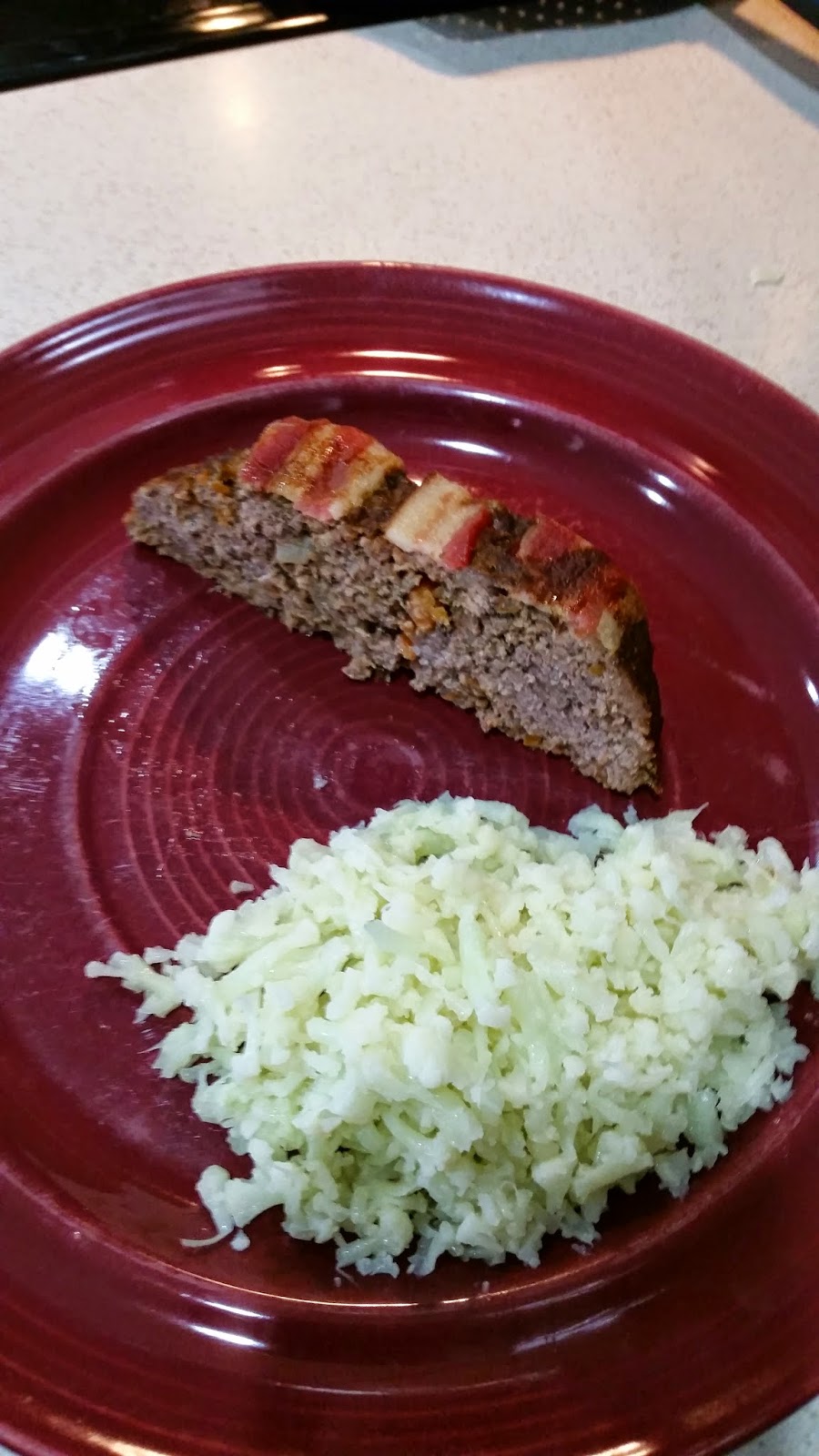
One of the easiest family meals to make it meatloaf.  Since cutting out the wheat this was a difficult at first as most meatloaf recipes call for breadcrumbs or stuffing mixes, which often are used to hold it together.  Without the use of a binding agent (breadcrumbs, rice, vegetables) your meatloaf might turn out like a brick.  This recipes is based on Dr. William Davis' book, Wheat Belly.  The main binding agents in this recipe are vegetables, eggs, and flax seed. I've made a few changes to make it our own, just as I encourage you to do.

Wheat-Belly Meatloaf
Serves 8

2 Tablespoons olive oil
1 Small onion, finely chopped
1 8 baby carrots, finely chopped
1 Rib of celery, finely chopped
2 Cloves of garlic, minced (I like to use my Pampered Chef Garlic Press)
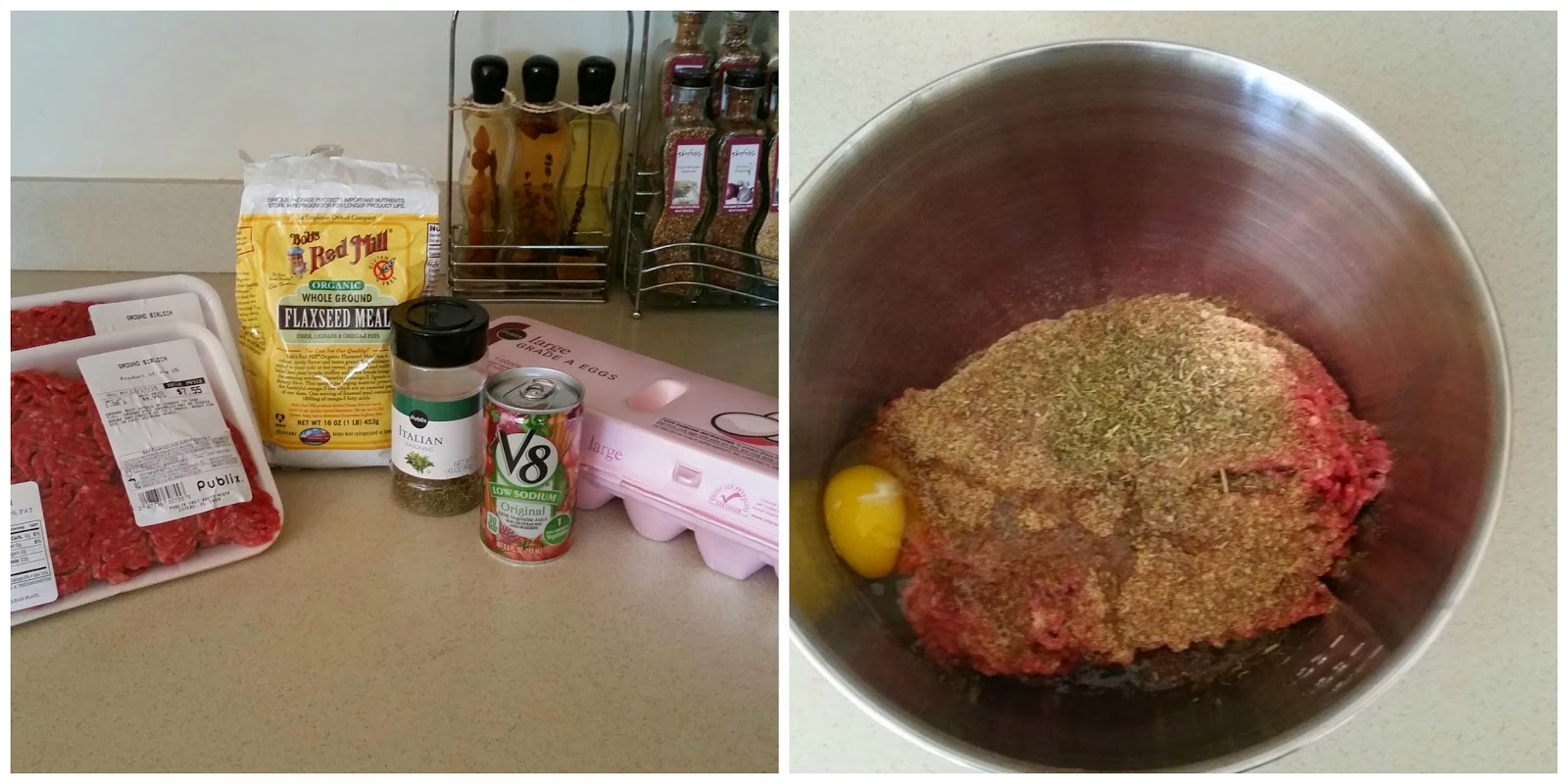
2 Pounds lean ground beef
1/4 Cup ground flax seed
2 Large eggs
1 Small (5.5oz) Can of V8
1/2 Teaspoon Italian Seasoning.
Salt & pepper to taste
3 Strips of bacon

Directions:
1.  Preheat oven to 350*F, and place aluminum foil in a baking sheet.
2.  Heat olive oil in large skillet over medium heat.
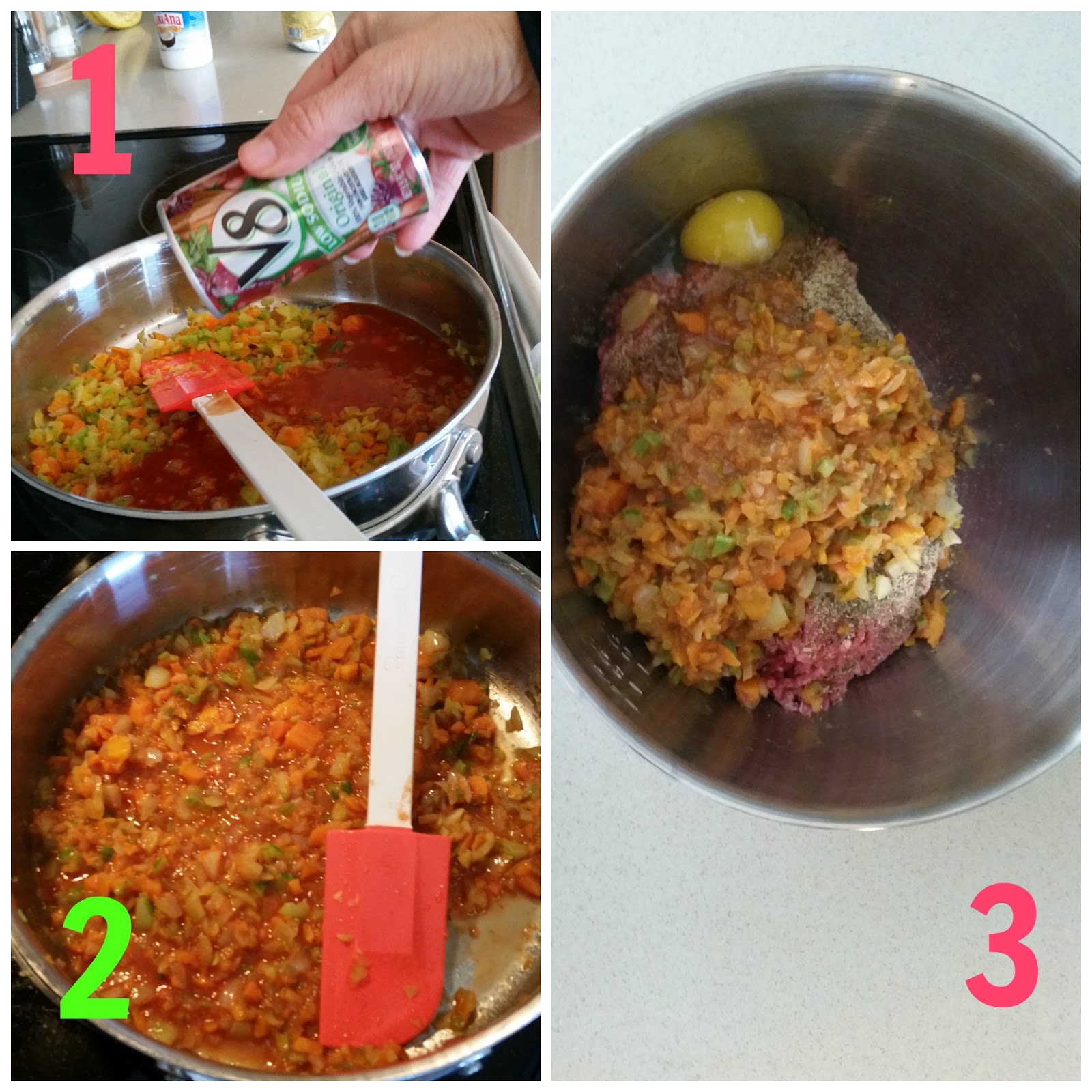
3.  Add finely chopped vegetables and garlic.  Saute for 5 minutes, until slightly tender. Then remove from heat and low to cool.
4.  Meanwhile, place ground beef, flax seed, eggs, Italian seasoning, salt, and pepper in a large bowl.
5.  Once vegetables are slightly cooled add in V8 and mix thoroughly.  Then add to meat mixture.
6. Combine the meat and vegetables with your hands.  One combined then transfer to baking sheet and form into a log.
7.  Lay strip of bacon on top.  Place in preheated oven for 1 hour, or until internal temperature is 160*F.
8.  Remove from oven and allow to rest for 10 minutes before serving.


Step 4
Step 5


Mashed Cauliflower
1 Large head of cauliflower, cup up
2-3 Tablespoons butter

Directions:
1.  Steam cauliflower until very tender.
2.  Add in butter and mash with hand masher until smooth.  OR place in blender or food processor with butter and blend until smooth.

I used the hand method in the pictures below and ended up with more of a cauliflower rice.  While the result still tasted good, I prefer the food processor for a more "mashed potato" texture.

Options: you made add in some Parmesan cheese, chives, or salt & pepper to taste.  However, I do not recommend adding in any liquids.


This is one my families favorite meals.  Even my 3  year old nephew couldn't get enough of this meatloaf.  Enjoy!

Friday, February 20, 2015

Xylitol: Lesson Learned

I love to bake!  It is a fun activity I have enjoyed since I was a little girl.  My mom and I even talked of opening our own bakery some day.  Even when I was in high school looking at colleges I considered attending Johnson & Whales University in South Carolina and pursue a career in cooking and baking.  But life took me in a different direction.

Baking is still something I enjoy.  But with the changes in our eating habits I looked for ways of "healthifying" recipes; and I still do.  In my search for a better sugar I found a product called Xyla at  one of my local health food stores.  If you've never hear of xylitol here is a little bit more information.  With a product that is good for teeth and doesn't create insulin spikes that lead to sugar and carbohydrate cravings how could I go wrong?

I have used Xyla for the past year and it has worked great in the cookies and treats.  On January 26, 2015 I made a no-bake cookie for my kids after school.  The recipe calls for 1/3 of a cup of sugar, and I just swapped out Xyla, like always.  Also included in the ingredients was cocoa.  I left them on the counter to harden.  After the whirlwind of other after school activities I came home to find the wax paper on the floor... and no cookies to be seen.  Enter our family dog Milly.  She has that look on her face like, what did I do?  At the time, I only thought of the 1 tablespoon of cocoa powder in the recipe.  Milly has gotten in to other treats before and did not have much of a reaction, so I didn't think much about it; just kept a little eye on her throughout the night.

Tuesday morning was another story.  Milly vomited.  A lot.  It scared me a little, so I called the vet. I was explaining the ingredients - oats, butter, cocoa, xylitol, flax seed, and vanilla.  When I said xylitol, the nurse had a sense of urgency in her voice that made me stop and remember the warning.  There is a warning on the back of the bag about how toxic it is for dogs.  Oh my goodness... what did I do?!?!

I rushed Milly to the vet.  They did initial blood-work and her liver enzymes were off the chart.  Upon calling Poison Control the vet was given a protocol to follow to treat Milly for xylitol toxicity.  I did not realize the care Milly was going to need over the next 24-48 hours, and was sent to the 24-hour emergency vet.

At the time Milly still seemed ok to me, just a little tired.  The emergency vet told me the next important test for Milly was a coagulation test.  This would determine how likely it was that she could bleed out.  Given the time that had passed since she ate the treats it could go either way.  Since it had taken her a long time to have a reaction it could mean her body had began to process the toxins, but also that her body had had enough and it was in her blood.

The coagulation test came back off the chart.  So our next step was to give her plasma and retest over the next 24 hours.  After the first round of plasma her levels were still off the chart.  We made the decision to try one more round of plasma, and another 24 hours at the emergency vet.  I began to think "what if this doesn't work?"  Then what?  That was a long, restless night.  Here is the dog that I love.  She's my running buddy, my confident (yes, I talk to my dog), and a loving member of our family.  I know she won't be around forever, but I never expected it to end like this, and so suddenly.

When I got the call Thursday morning and it was the news I had been waiting to hear.  Milly's coagulation levels were normal!  She could come home!  I was so relieved.  But, we still have a long way to go.  While Milly's coagulation levels are ok, her liver enzymes are still off the chart and she is still at risk for liver failure.  But we are able to treat her at home with medications - 4 in all - over the next 30 days.

This has been a scary experience for all of us.  I am happy Milly is still here.  It makes me want to spread the word on how dangerous xylitol can be for dogs, and caution other dog owners to be careful of your baked treats and your sugar free gum, and anything else that is deemed dangerous for dogs.

I will continue to bake in a healthy way.  But this has been a lesson to be careful.  What is healthy for us is not always healthy for our furry friends.